Choosing construction materials is not just a matter of comparing labels. A low-carbon product can still travel far, require intensive processing, or perform poorly in a specific climate. Good sourcing weighs these factors alongside durability, maintenance, and end-of-life options.
Architect and sustainability advocate William McDonough, co-author of Cradle to Cradle, expresses a core circular-design idea as: “Waste equals food.” It is a useful challenge for construction teams: can one material’s offcuts or future components serve another purpose? In practice, the answer depends on clear product data, reliable suppliers, and details such as coatings, adhesives, and local recycling capacity. The slogan is simple. The decisions are not.
This guide to the 10 best sustainable materials for construction sourcing examines options such as reclaimed timber, recycled steel, bamboo, and low-carbon concrete. It considers where each can fit, what evidence buyers should request, and which trade-offs deserve a closer look. No material is automatically sustainable in every project. A nearby, responsibly sourced product may be the better choice, but distance alone does not prove impact. Sustainable Material Sourcing For Construction requires checking the full picture, not just the marketing claim. Expect practical guidance, not a perfect-material fairy tale.
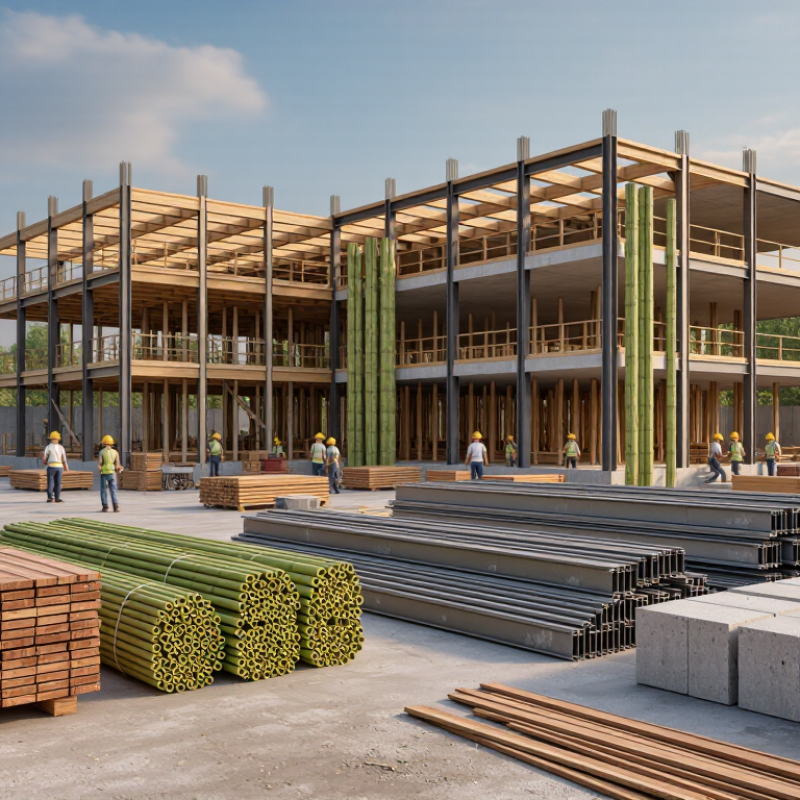
A sustainable construction material is not defined by one label or a high recycled-content figure. Its impact depends on the full life cycle: extracting raw materials, manufacturing, transport, installation, and eventual reuse or disposal. A product made with less energy may still perform poorly if it needs frequent replacement. The details matter.
Look for credible environmental product declarations, verified sourcing information, and clear data on recycled or renewable content. These documents help compare products, but they are not perfect; boundaries and assumptions can differ. Ask suppliers how figures were measured, and check whether the material suits the project’s climate and intended use. Reclaimed timber, for example, can reduce demand for new resources, but moisture exposure and grading still need careful assessment. Durable beats fashionable.
Consider what happens on site and decades later. Can components be repaired, separated, or reused without excessive damage? Is the material available nearby, with reliable quality and manageable transport? A short delivery route helps, though it does not erase the impact of energy-intensive production. There are trade-offs. Good sourcing balances measured environmental impacts with safety, durability, maintenance, and local availability. Where evidence is incomplete, record the uncertainty instead of treating a supplier claim as proof.
| Material | Typical construction uses | Sustainability strengths | Important limitations | What to check when sourcing |
|---|---|---|---|---|
| Reclaimed timber | Beams, flooring, cladding, doors and interior finishes | Reuses existing material and can reduce demand for newly harvested wood and disposal. | Supply, dimensions and grading can be inconsistent; coatings or past treatments may require investigation. | Confirm origin, species, structural grade where relevant, moisture condition and any treatment or coating history. |
| Responsibly sourced timber | Framing, roof structures, floors, doors and cladding | Wood is renewable when forests are managed responsibly; it can store biogenic carbon during the product’s service life. | Benefits depend on forest management, product lifetime, land-use impacts and end-of-life treatment. | Request chain-of-custody documentation, legal-harvest evidence, species details and an environmental product declaration (EPD), if available. |
| Bamboo products | Flooring, panels, screens and selected engineered components | Bamboo is a fast-growing grass that can regenerate after harvesting, depending on species and management. | Processed products may use adhesives; long-distance transport and land-use practices affect overall impacts. | Check growing and processing locations, adhesive emissions, durability, product testing and EPD data. |
| Recycled steel | Structural frames, reinforcement, roofing and building components | Steel is highly recyclable, and scrap-based production can have lower embodied emissions than primary production. | Emissions vary substantially with production route, electricity mix, recycled content and transport. | Compare product-specific EPDs, recycled-content data, production route, declared unit and structural specifications. |
| Recycled aluminum | Window and door frames, façades, roofing and fittings | Recycling aluminum generally requires much less energy than producing primary aluminum from ore, and the material can be recycled repeatedly. | Primary aluminum production is energy-intensive; recycled content and fabrication impacts differ by product. | Verify recycled-content claims, alloy suitability, finish, service life and product-specific EPD results. |
| Concrete with supplementary cementitious materials | Foundations, slabs, walls and structural elements | Replacing part of the Portland cement with suitable supplementary materials can reduce cement-related emissions. | Availability and performance vary; mix design, curing, local standards and material supply affect results. | Compare EPDs for the required strength and exposure class; confirm mix proportions, curing needs and local code compliance. |
| Rammed earth | Walls and selected thermal-mass applications | Can use locally available mineral soil and may need little processing when suitable soil is available nearby. | Soil suitability, weather protection, structural design and the use of stabilizers influence impacts and performance. | Test soil composition and strength; document stabilizer content, sourcing distance, moisture protection and construction method. |
| Hemp-lime (hempcrete) | Non-load-bearing wall infill and insulation systems | Uses hemp shiv with a mineral binder; hemp is an annually grown crop, and the wall assembly can provide thermal and moisture-buffering functions. | Usually not load-bearing by itself; binder type, drying time, detailing and local availability matter. | Check the full system specification, binder composition, thermal performance, fire testing, moisture detailing and code acceptance. |
| Cellulose insulation | Attics, cavity walls and some retrofit insulation systems | Often made largely from recycled paper fibre and can reduce heat loss when correctly installed. | Performance depends on density, installation quality, moisture control and fire-retardant formulation. | Verify recycled content, declared thermal conductivity, fire and pest-treatment information, moisture guidance and installer qualifications. |
| Recycled glass products | Glass wool insulation, tiles, terrazzo and selected aggregate applications | Can divert recovered glass from disposal and reduce demand for virgin feedstock, depending on the product and manufacturing process. | Recycled content, energy use and performance differ widely among product types. | Check verified recycled content, product-specific EPD, durability, thermal or structural performance and end-of-life options. |
Note: “Sustainable” depends on the project, local supply, service life, performance and end-of-life pathway. Compare products using equivalent functions and product-specific EPDs where available.
Start with the project’s lifespan, climate, structural needs, and maintenance plan. A low-impact option may disappoint if it needs frequent replacement.
Request environmental product declarations, recycled-content details, sourcing records, and manufacturing locations. Check which life-cycle stages each declaration covers.
Not always. Figures may use different boundaries or assumptions, so compare like with like and record uncertainties.
Bamboo, reclaimed timber, and recycled steel are options. Their suitability still depends on sourcing, durability, and the building’s needs.
Low-carbon concrete, rammed earth, straw bale, cork, cellulose insulation, recycled glass, and hemp-lime. Small choices matter.
Consider thermal performance, fire behavior, and installation requirements together. Ask for a sample if handling may affect installation.
No. Distance matters, but production methods and durability matter too. Local availability can still help with lead times and repairs.
Talk with contractors about availability, repair methods, and end-of-life options. Record assumptions and revisit them before purchase. I still find early estimates easy to overtrust.
Sustainable Material Sourcing For Construction begins with understanding how a material affects the environment throughout its life cycle, from extraction and manufacturing to transportation, use, and eventual reuse or disposal. A responsible evaluation also considers durability, recycled or renewable content, energy and water demands, indoor air quality, and the availability of reliable information about a material’s origin. These factors help project teams compare options beyond appearance or initial price.
Ten useful material categories for building projects include reclaimed wood, recycled steel, bamboo, cork, straw-based products, recycled-content concrete, low-carbon cement alternatives, responsibly sourced timber, natural-fiber insulation, and locally available stone. Each option should be assessed against project needs, including structural performance, maintenance, cost, and supply availability. Buyers can verify suppliers by reviewing documentation, origin records, and relevant environmental or quality certifications, then comparing evidence across alternatives. A balanced sourcing decision can reduce environmental impacts while maintaining safety, function, and long-term value.

 YVC Home